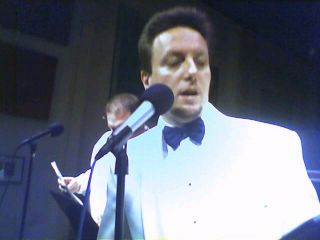
He has been in some of the most important films of the seventies...
 ...one of his first big movie appearances was as Gene Hackman's partner in "The French Connection"...
 ... and it would surprise me to know that you hadn't seen him in "Jaws"...
 ...but my favorite film he ever did was "All That Jazz". At 47. Amazing.
He passed away on Sunday 2/10. Here's the obituary from The New York Times...
Roy Scheider, Actor in ‘Jaws,’ Dies at 75
Roy Scheider, a stage actor with a background in the classics who became one of the leading figures in the American film renaissance of the 1970s, died on Sunday afternoon in Little Rock, Ark. He was 75 and lived in Sag Harbor, N.Y.
Mr. Scheider had suffered from multiple myeloma for several years, and died of complications from a staph infection, his wife, Brenda Siemer, said.
Mr. Scheider’s rangy figure, gaunt face and emotional openness made him particularly appealing in everyman roles, most famously as the agonized police chief of “Jaws,” Steven Spielberg’s 1975 breakthrough hit, about a New England resort town haunted by the knowledge that a killer shark is preying on the local beaches.
Mr. Scheider conveyed an accelerated metabolism in movies like “Klute” (1971), his first major film role, in which he played a threatening pimp to Jane Fonda’s New York call girl; and in William Friedkin’s “French Connection” (also 1971), as Buddy Russo, the slightly more restrained partner to Gene Hackman’s marauding police detective, Popeye Doyle. That role earned Mr. Scheider the first of two Oscar nominations.
Born in 1932 in Orange, N.J., Mr. Scheider earned his distinctive broken nose in the New Jersey Diamond Gloves Competition. He studied at Rutgers and at Franklin and Marshall College in Lancaster, Pa., where he graduated as a history major with the intention of going to law school. He served three years in the United States Air Force, rising to the rank of first lieutenant. When he was discharged, he returned to Franklin and Marshall to star in a production of “Richard III.”
His professional debut was as Mercutio in a 1961 New York Shakespeare Festival production of “Romeo and Juliet.” While continuing to work onstage, he made his movie debut in “The Curse of the Living Corpse” (1964), a low-budget horror film by the prolific schlockmeister Del Tenney. “He had to bend his knees to die into a moat full of quicksand up in Connecticut,” recalled Ms. Siemer, a documentary filmmaker. “He loved to demonstrate that.”
His professional debut was as Mercutio in a 1961 New York Shakespeare Festival production of “Romeo and Juliet.” While continuing to work onstage, he made his movie debut in “The Curse of the Living Corpse” (1964), a low-budget horror film by the prolific schlockmeister Del Tenney. “He had to bend his knees to die into a moat full of quicksand up in Connecticut,” recalled Ms. Siemer, a documentary filmmaker. “He loved to demonstrate that.”
In 1977 Mr. Scheider worked with Mr. Friedkin again in “Sorcerer,” a big-budget remake of Henri-Georges Clouzot’s 1953 French thriller, “The Wages of Fear,” about transporting a dangerous load of nitroglycerine in South America.
Offered a leading role in “The Deer Hunter” (1979), Mr. Scheider had to turn it down in order to fulfill his contract with Universal for a sequel to “Jaws.” (The part went to Robert De Niro.)
“Jaws 2” failed to recapture the appeal of the first film, but Mr. Scheider bounced back, accepting the principal role in Bob Fosse’s autobiographical phantasmagoria of 1979, “All That Jazz.” Equipped with Mr. Fosse’s Mephistophelean beard and manic drive, Mr. Scheider’s character, Joe Gideon, gobbled amphetamines in an attempt to stage a new Broadway show while completing the editing of a film (and pursuing a parade of alluring young women) — a monumental act of self-abuse that leads to open-heart surgery. This won Mr. Scheider an Academy Award nomination in the best actor category. (Dustin Hoffman won that year, for “Kramer vs. Kramer.”)
In 1980, Mr. Scheider returned to his first love, the stage, where his performance in a production of Harold Pinter’s “Betrayal” opposite Blythe Danner and Raul Julia earned him the Drama League of New York award for distinguished performance. Although he continued to be active in films, notably in Robert Benton’s “Still of the Night” (1982) and John Badham’s action spectacular “Blue Thunder” (1983), he moved from leading men to character roles, including an American spy in Fred Schepisi’s “Russia House” (1990) and a calculating Mafia don in “Romeo Is Bleeding” (1993).
One of the most memorable performances of his late career was as the sinister, wisecracking Dr. Benway in David Cronenberg’s adaptation of William S. Burroughs’s “Naked Lunch” (1991).
Living in Sag Harbor, Mr. Scheider continued to appear in films and lend his voice to documentaries, becoming, Ms. Siemer said, increasingly politically active. With the poet Kathy Engle, he helped to found the Hayground School in Bridgehampton, dedicated to creating an innovative, culturally diverse learning environment for local children. At the time of his death, Mr. Scheider was involved in a project to build a film studio in Florence, Italy, for a series about the history of the Renaissance.
Besides his wife, his survivors include three children, Christian Verrier Scheider and Molly Mae Scheider, with Ms. Siemer, and Maximillia Connelly Lord, from an earlier marriage, to Cynthia Bebout; a brother, Glenn Scheider of Summit, N.J.; and two grandchildren.
He always seemed to me to be a combination of street smart, but very sophisticated as well. Watch him in Coppola's Grisham movie "The Rainmaker" as Wilfred Keeley the head of the insurance company that's being sued and see a great actor sketch in blase evil with just a few strokes.
He will be missed and my thoughts and prayers go to his family and friends.